Fish Tapeworm
(Diphyllobothrium latum )
Key Points
- Acquired by the consumption of under or uncooked infected fish
- Multicellular endoparasites
- Diphyllobothriasis is often asymptomatic
Classification
Fish tape worms, scientifically known as Diphyllobothrium latum , are multicellular animal parasites. They are considered to be endoparasites, as most of their life cycle takes place within another organism. They are Helminthes, belonging to the Platyhelminthes phylum.
Biology and Mode of Transmission

Image: https://www.cdc.gov/parasites/diphyllobothrium/biology.html
Unembryonatred eggs are released in the definitive hosts feces. In water the eggs are able to develop an embryo. Coracidia are then born from the eggs. Crustaceans act as the first intermediate host and ingest the coracidia. The first stage of larvae develop within the crustaceans. The crustacean is then ingested by the second intermediate host. Typically the second intermediate host is a fish. In the second intermediate host, procercoid larvae are able to develop into plerocercoid larvae. Larger fish may become paratenic hosts, but are not required in the life cycle. Plerocercoid invade the tissues of intermediate host. Definitive hosts are organisms that then consume the improperly cooked infected intermediate or paretenic host. The fish tape worm infection, called Diphyllobothriasis, can occur in both humans and fish eating animals. Diphyllobothrium latum resides in the small intestine of the definitive host where it reaches sexual maturity. Eggs are released in host feces and the life cycle repeats.
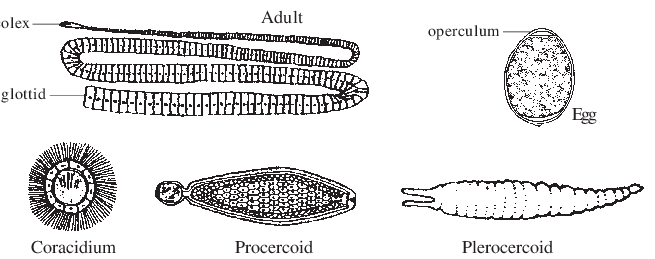
Site of Infection, Pathology and Disease Symptoms
Diphyllobothriasis, in humans, occurs only in the small intestine. It is generally asymptomatic and only discovered in the incidence that the host notices eggs of tapeworm segments in their stool. Symptoms occur in less than 22% of infections and may include:
- abdominal cramps
- nausea
- loose bowel movement
- A deficiency of vitamin B12 causing anemia
Treatment
Drugs for multicellular endoparasites include:
- Mebendazole which blocks cytoskeleton formation and inhibits glucose uptake; working together to deter the worms mobility
- Ivermectin paralyzes intestinal worms
Most often prescribed drugs include praziquantel, which causes muscles spasms effecting the worms ability to attach to the intestinal wall, and niclosamide which kills the worm. Peristalsis then forces the worm to exit the host.
In some cases surgical intervention may be required to remove tapeworm.
Prevention
Physical methods of microbial control must be used; including Heat and Low Temperatures
- When cooked, Fish should reach an internal temperature of at least 145° F
- Flash freezing is an effective technique used for killing multi-cellular parasites
- Fish being stored should be kept frozen at a temperature below 14°F
Other methods of preventing Diphyllobothriasis
- Research food handling practices in developing countries you intend to visit and take the necessary precautions before consuming food there
- Ensuring proper disposal of human waste and adequate water treatment (this can not eliminate the risk of diphyllobothriasis completely as other fish eating mammals and birds can be definitive hosts)
Anatomy of a Tapeworm
Can be 2-10 meters long!

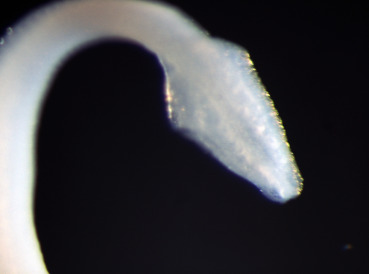
The Scolex
- The “head”
- Usually contain hooks and suckers which allow for attachment to intestinal wall ( Diphyllobothrium latum is an exception)
- Different tapeworms can be identified by the shape of the scolex
Proglottids
- segments
- contain reproductive organs
- When reproduction is complete, the egg filled proglottids are shed with feces

https://www.alamy.com/animal-parasites-and-human-disease-insects-as-carriers-of-disease-medical-parasitology-b-i-fig-87-heads-of-some-adult-tapeworms-found-in-man-drawn-to-scale-a-beef-tapeworm-taenia-saginata-b-pork-tapeworm-t-nolium-c-fish-tapeworm-dibothriocephalus-latus-d-heart-headed-tapeworm-dihothriocephalus-cordatiis-e-african-tapeworm-t-africana-f-double-pored-dog-tapeworm-dipylidium-caninum-g-dwarf-tapeworm-hymenolepis-nana-h-rat-tapeworm-hymcnolipis-diminuta-x-10-mind-the-various-ways-in-which-the-eggs-may-be-disseminated-by-streams-rain-flies-etc-the-eggs-of-the-image236748208.html
Gallery

https://www.alamy.com/stock-photo/diphyllobothrium-latum.html 
https://www.alamy.com/stock-photo/diphyllobothrium-latum.html 
https://www.sciencedirect.com/topics/immunology-and-microbiology/coracidium 
https://www.netterimages.com/image_print.htm?code=fish-tapeworm-infection-life-cycle-of-diphyllobothrium-latum-labeled-floch-2e-gastroenterology-frank-h-netter-6778&price=&usg=&items=0&books=false&versions=false&0.5931913442909718 
https://www.sciencedirect.com/topics/biochemistry-genetics-and-molecular-biology/diphyllobothrium-latum 
Image 2: https://www.alamy.com/stock-photo/diphyllobothrium-latum.html
Image 3: https://www.sciencedirect.com/topics/immunology-and-microbiology/coracidium
Image 4:https://www.netterimages.com/image_print.htm?code=fish-tapeworm-infection-life-cycle-of-diphyllobothrium-latum-labeled-floch-2e-gastroenterology-frank-h-netter-6778&price=&usg=&items=0&books=false&versions=false&0.5931913442909718
Image 5: https://emedicine.medscape.com/article/216089-overview
Image 6: https://www.sciencedirect.com/topics/biochemistry-genetics-and-molecular-biology/diphyllobothrium-latum
Image 7: https://www.sciencedirect.com/topics/biochemistry-genetics-and-molecular-biology/diphyllobothrium-latum
References/ Additional Resources
- https://www.cdc.gov/parasites/diphyllobothrium/biology.html
- https://www.cdc.gov/dpdx/diphyllobothriasis/index.html
- http://www.eedsfiles.com/Activity_Files/005171787/5962.pdf
- https://emedicine.medscape.com/article/216089-overview
- https://www.sciencedirect.com/topics/immunology-and-microbiology/coracidium
- https://www.ncbi.nlm.nih.gov/pmc/articles/PMC2620636/
- https://www.mayoclinic.org/diseases-conditions/tapeworm/symptoms-causes/syc-20378174
- Edwards, Angela. Fahnet, Beatrix. Pryor, Gregory. Strelkauskas, Anthony. Strelkauskas, Jennifer., Microbiology a clinical approach, 2nd Edition
- https://www.nytimes.com/2015/05/19/science/freezing-fish-killing-parasites.html
- https://aibolita.com/infectious-diseases/41130-clinical-presentation-and-manifestations.html
 Fish Tapeworm By Samantha Bizuns